
What Are the Different Types of Property Management?
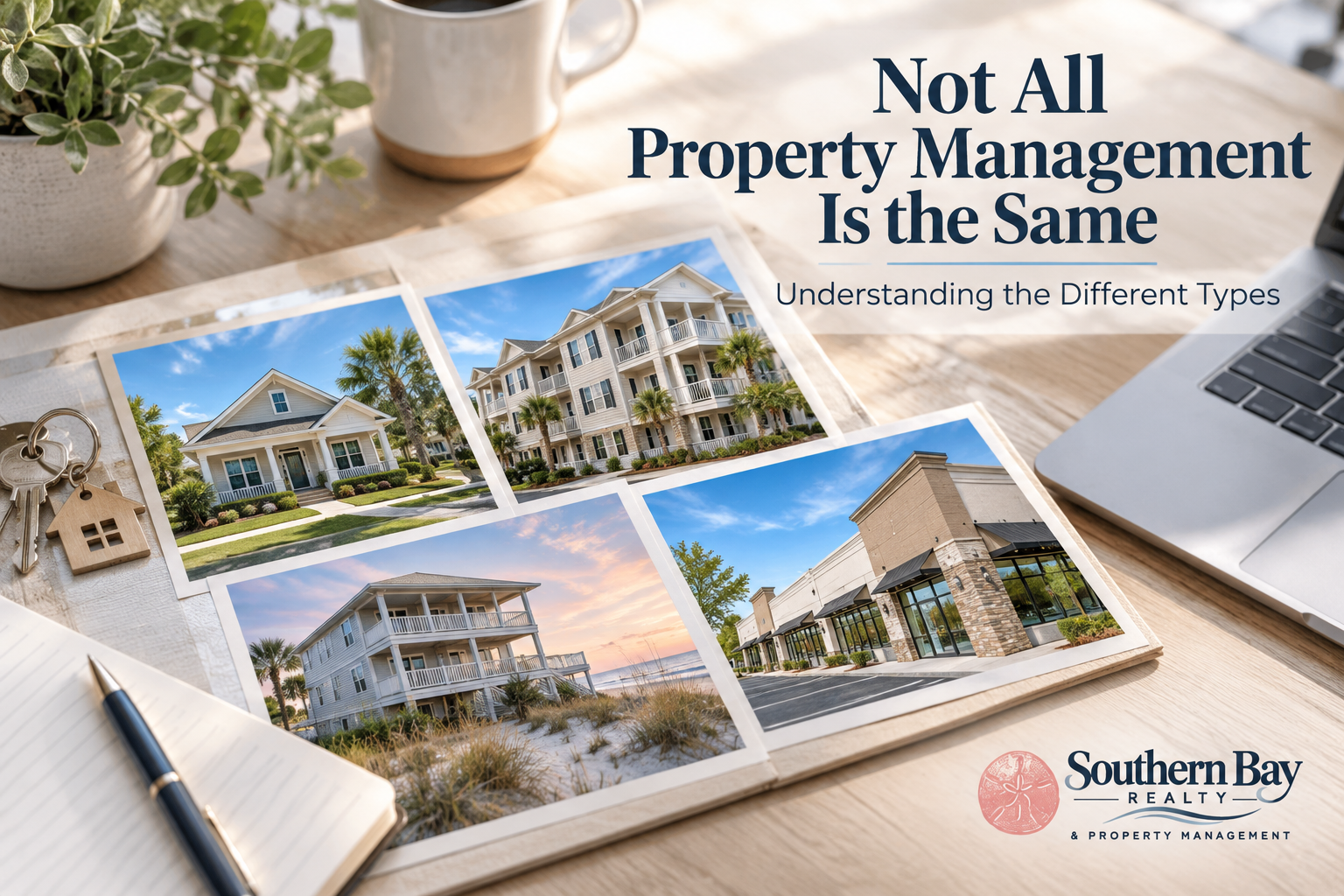
Property management is a broad term, but managing a single-family rental home is very different from managing a beachfront vacation rental, a large apartment property, a commercial building, or a homeowners association.
The basic purpose is similar: protect the property, organize operations, communicate with the people who use it, maintain records, coordinate maintenance, and help the owner or association operate effectively.
But the day-to-day work can be dramatically different depending on the property type.
A long-term rental manager may focus heavily on tenant screening, annual leases, rent collection, maintenance, renewals, and vacancy. A vacation-rental manager may deal with nightly pricing, frequent turnovers, guest communication, cleaning, platform listings, furnishing, and seasonality. An HOA manager works with a board and homeowners rather than serving as the landlord for the individual homes.
Property Management Is Only One Part of Real Estate Management
People often use “property management” and “real estate management” interchangeably, but there can be an important difference.
Property management usually refers to the hands-on operational work required to keep a property functioning.
Buildium describes property management as the operational side of real estate management, including tenant relations, rent collection, maintenance, leasing, financial reporting, and compliance.
You can read more in Buildium's guide to real estate management .
Common property-management responsibilities include:
- Leasing
- Rent or assessment collection
- Tenant or resident communication
- Maintenance coordination
- Vendor management
- Property accounting
- Inspections
- Financial reporting
- Recordkeeping
- Compliance procedures
The exact combination depends heavily on what is being managed.
1. Long-Term Residential Property Management
Long-term residential management typically involves homes rented to tenants under leases lasting several months or longer.
This can include:
- Single-family homes
- Townhomes
- Duplexes
- Small multifamily properties
- Individual condominium units
Typical management responsibilities
- Rental-price analysis
- Advertising
- Showings
- Applications
- Tenant screening
- Lease preparation
- Rent collection
- Maintenance coordination
- Inspections
- Renewals
- Move-outs
- Owner reporting
Because the tenant may remain in the property for a year or longer, tenant selection and lease administration become especially important.
Long-term rental managers also need systems for late rent, maintenance requests, property access, renewals, security deposits, tenant communication, and turnover.
2. Multifamily Property Management
Multifamily management shares many characteristics with single-family rental management but becomes more operationally complex as the number of units increases.
A manager may oversee:
- Duplexes and triplexes
- Small apartment buildings
- Large apartment communities
- Mixed residential complexes
Why multifamily is different
Instead of managing one tenancy and one set of property systems, the manager may be handling dozens or hundreds of residents at the same physical property.
That creates additional considerations involving:
- Unit turnover
- Shared utilities
- Common areas
- Parking
- Community rules
- On-site maintenance
- Staffing
- Vendor contracts
- Building systems
- Occupancy reporting
Large multifamily properties may require dedicated maintenance personnel, leasing staff, or on-site management that would be unnecessary for a portfolio of scattered single-family homes.
Financial reporting can also become more complex because the owner may need to track occupancy, rent levels, concessions, unit-level performance, payroll, common-area expenses, and larger capital projects.
Back to Top ↑3. Vacation and Short-Term Rental Management
Vacation-rental management is very different from traditional long-term residential management.
A long-term rental manager may lease a property once and manage the same tenant for an entire year.
A vacation-rental manager may effectively lease the property dozens of times during that same period.
Vacation-rental management may involve:
- Dynamic nightly pricing
- Platform management
- Guest communication
- Reservation management
- Frequent cleaning
- Linen coordination
- Turnover inspections
- Furnishing and inventory
- Guest reviews
- Seasonal pricing strategy
- Local lodging requirements
- Frequent maintenance response
Revenue analysis is also different
Long-term rental pricing usually begins with a monthly market rent.
Vacation-rental performance may depend on:
- Nightly rates
- Seasonality
- Weekday versus weekend demand
- Special events
- Minimum stays
- Occupancy percentage
- Cleaning charges
- Platform fees
- Furnishing costs
- Utilities
- Guest amenities
That can be particularly important in coastal markets such as Gulf Shores, Orange Beach, Fort Morgan, and Dauphin Island, where demand can fluctuate substantially throughout the year.
4. HOA and Community Association Management
HOA management is fundamentally different from rental property management.
In a traditional rental-management relationship, the property manager represents an owner who leases property to a tenant.
In a homeowners association, the residents generally own their own properties while the association manages common responsibilities through a governing board.
Buildium describes community-association management as working with boards of directors, managing common areas, collecting dues and assessments, administering governing documents, and coordinating community-wide projects.
Association management may include:
- Board support
- Homeowner communication
- Assessment collection
- Budget administration
- Financial reporting
- Vendor coordination
- Common-area maintenance
- Meeting coordination
- Recordkeeping
- Violation administration
- Insurance coordination
- Reserve planning support
The board still governs the association
A professional association manager generally supports and administers the association rather than replacing the board's governing authority.
The board makes decisions within its governing authority, while management helps execute those decisions and maintain the operational systems around them.
5. Commercial Property Management
Commercial real estate management can include office, retail, industrial, warehouse, and other business-use property.
Buildium notes that commercial management can involve longer lease terms, different accounting structures, tenant improvements, and more complex building systems than ordinary residential management.
Commercial managers may deal with:
- Office leases
- Retail leases
- Industrial tenants
- Triple-net structures
- Common-area expenses
- Tenant improvements
- Commercial insurance
- Building systems
- Business tenants
- Longer lease negotiations
Commercial lease structures can be substantially different from ordinary residential leases.
The allocation of taxes, insurance, maintenance, utilities, common-area costs, improvements, and repairs can vary considerably depending on the agreement.
6. Property Management vs. Real Estate Asset Management
Property management focuses primarily on operating the property.
Asset management looks more closely at the financial strategy behind the property.
Buildium describes asset management as focusing on whether a property is meeting its financial targets and may include evaluating income and expenses, rental strategy, capital improvements, and long-term performance.
A property manager may ask:
- Has rent been collected?
- Is the tenant's maintenance request complete?
- Is the lease expiring?
- Does the HVAC need repair?
An asset manager may ask:
- Is this property meeting our return target?
- Should we renovate the units?
- Would higher rents justify the improvement?
- Should we refinance?
- Should we sell?
- Should capital be deployed elsewhere?
7. Portfolio Management Looks Across Multiple Properties
An investor with several properties may eventually need to think beyond each individual rental.
Buildium describes portfolio management as looking across a collection of properties to balance risk, allocate capital, evaluate performance, and determine where future investment should occur.
Portfolio-level questions might include:
- Which properties produce the strongest return?
- Where is too much capital concentrated?
- Which properties require major repairs?
- Should one property be sold?
- Should another property be refinanced?
- Which market should receive new investment?
- Is the portfolio overly dependent on one strategy?
- How much liquidity should be maintained?
An individual rental can be performing reasonably well while still being a poor fit for the investor's overall portfolio.
Why the Type of Property Management Matters
The management category affects nearly every part of the operation.
Different property types can require different approaches to:
- Leasing
- Pricing
- Accounting
- Maintenance
- Communication
- Inspections
- Vendor relationships
- Legal compliance
- Technology
- Staffing
- Reporting
- Marketing
For example, a single-family rental may require one tenant ledger and occasional maintenance.
A vacation rental may generate dozens of reservations and turnovers.
An HOA may involve hundreds of homeowners, a board of directors, common-area vendors, assessment accounting, and annual budgeting.
A commercial building may involve business tenants, complex leases, common-area charges, and significant building systems.
How Do You Choose the Right Type of Property Manager?
Begin by evaluating the company's experience with your exact property type.
Buildium recommends evaluating management companies based on factors such as property-type experience, technology, communication practices, and the services included in the management agreement.
Ask prospective managers:
- What types of properties do you primarily manage?
- How many similar properties do you manage?
- What services are included?
- What services cost extra?
- How do you handle maintenance?
- What software do owners use?
- How is financial reporting handled?
- How often will I hear from you?
- What authority do you have to spend money?
- How can the agreement be terminated?
You should also understand how the manager handles the common problems associated with your type of property.
Our guide to common property management challenges and how to overcome them explains several issues owners should expect professional managers to have systems for handling.
Can You Manage Property Yourself?
Yes. Many property owners successfully self-manage.
The question is whether you have the time, systems, experience, and interest required for the type of property you own.
Self-management may be practical if you:
- Live close to the property
- Have adequate time
- Understand the rental market
- Keep organized financial records
- Have reliable contractors
- Respond quickly to residents
- Understand leasing procedures
- Are comfortable handling difficult situations
But management becomes more difficult as the property type becomes more operationally intensive or the portfolio grows.
Vacation rentals can require near-daily operations. Multifamily communities can generate constant maintenance and resident activity. HOAs involve boards, budgets, governing documents, vendors, and owner communications.
Our article on the benefits of using a property manager explains when delegating the day-to-day work may make sense.
Frequently Asked Questions About Types of Property Management
What are the main types of property management?
Common categories include long-term residential management, multifamily management, vacation or short-term rental management, HOA and community-association management, and commercial property management.
Is residential property management the same as commercial property management?
No. While both involve leasing, maintenance, financial reporting, and property operations, commercial properties often use different lease structures, expense allocations, tenant-improvement arrangements, and building systems.
Is vacation-rental management the same as long-term rental management?
No. Vacation rentals typically involve frequent guest turnover, nightly pricing, reservation management, cleaning, furnishing, platform listings, guest communication, and substantial seasonality.
Is HOA management the same as rental management?
No. A rental manager typically represents a property owner in a landlord-tenant relationship. An HOA manager generally supports an association and its board while helping administer common property, assessments, records, vendors, meetings, and governing procedures.
What is multifamily property management?
Multifamily management involves rental properties containing multiple residential units. Larger communities can require leasing staff, maintenance personnel, common-area management, building systems, and more complex accounting.
What is real estate asset management?
Asset management focuses more heavily on the financial strategy and long-term performance of a property, including income, expenses, capital improvements, financing, return targets, and potential disposition.
What is portfolio management?
Portfolio management evaluates multiple properties together rather than treating each property as an isolated investment. It can involve capital allocation, risk management, diversification, performance comparisons, and acquisition or disposition decisions.
Can the same company manage different types of properties?
Yes, if the company has appropriate systems, personnel, experience, and expertise for each category. Owners should verify actual experience rather than assuming every management model operates the same way.
Can a long-term rental manager manage my Airbnb?
Possibly, but long-term and vacation-rental management require substantially different systems. Ask specifically about dynamic pricing, reservation platforms, cleaning, guest communication, furnishing, occupancy, and short-term rental operations.
What kind of property manager do I need for a single-family rental?
A residential long-term property manager is usually the most relevant fit when the home is being leased to tenants under traditional longer-term leases.
What kind of management does an HOA need?
An HOA generally needs community-association management rather than traditional landlord-tenant management. The company should understand board support, assessments, budgets, governing documents, common-area maintenance, vendor coordination, and owner communications.
What type of manager does a commercial building need?
A commercial property manager with experience in the building type and applicable lease structures is generally more appropriate than a manager focused exclusively on residential rentals.
How do I know whether a property manager is qualified?
Ask about experience with your property type, management systems, communication, accounting, maintenance procedures, technology, services, fees, and the terms of the management agreement.
Does property management include financial reporting?
Professional management commonly includes some form of owner or association financial reporting, although the exact reports and accounting responsibilities depend on the management agreement and property type.
Does property management include asset management?
Sometimes there is overlap, but the functions are different. Property management focuses primarily on operations, while asset management focuses more heavily on financial performance and long-term strategy.
Should investors hire a property manager or an asset manager?
That depends on the investor's needs. An owner primarily seeking help with tenants, maintenance, leasing, and rent collection may need property management. A larger investor focused on portfolio performance, capital allocation, and strategic decisions may also benefit from asset-management functions.
Back to Top ↑Final Thoughts: Match the Manager to the Property
Property management is not one universal discipline.
The manager of a single-family rental, the manager of a beachfront vacation condo, the manager of a large apartment community, and the manager of a homeowners association may all work in property management—but their daily responsibilities can be dramatically different.
Buildium describes property management as the operational backbone of broader real estate management, while also distinguishing it from asset management, portfolio management, and development or investment management. :contentReference[oaicite:2]{index=2}
That distinction matters because owners need more than someone who can collect money and call a contractor.
They need a management system appropriate for the type of property they actually own.
Southern Bay Realty helps property owners and associations throughout Mobile and Baldwin County with real estate and property-management services built around the specific needs of the property rather than treating every ownership situation the same way.
Back to Top ↑Need Professional Property Management?
Southern Bay Realty can help you evaluate the type of management your property requires and determine whether professional oversight makes sense for your ownership goals in Mobile or Baldwin County.
Talk With Southern Bay Realty