
Understanding Property Management Fees: What Are You Really Paying For?
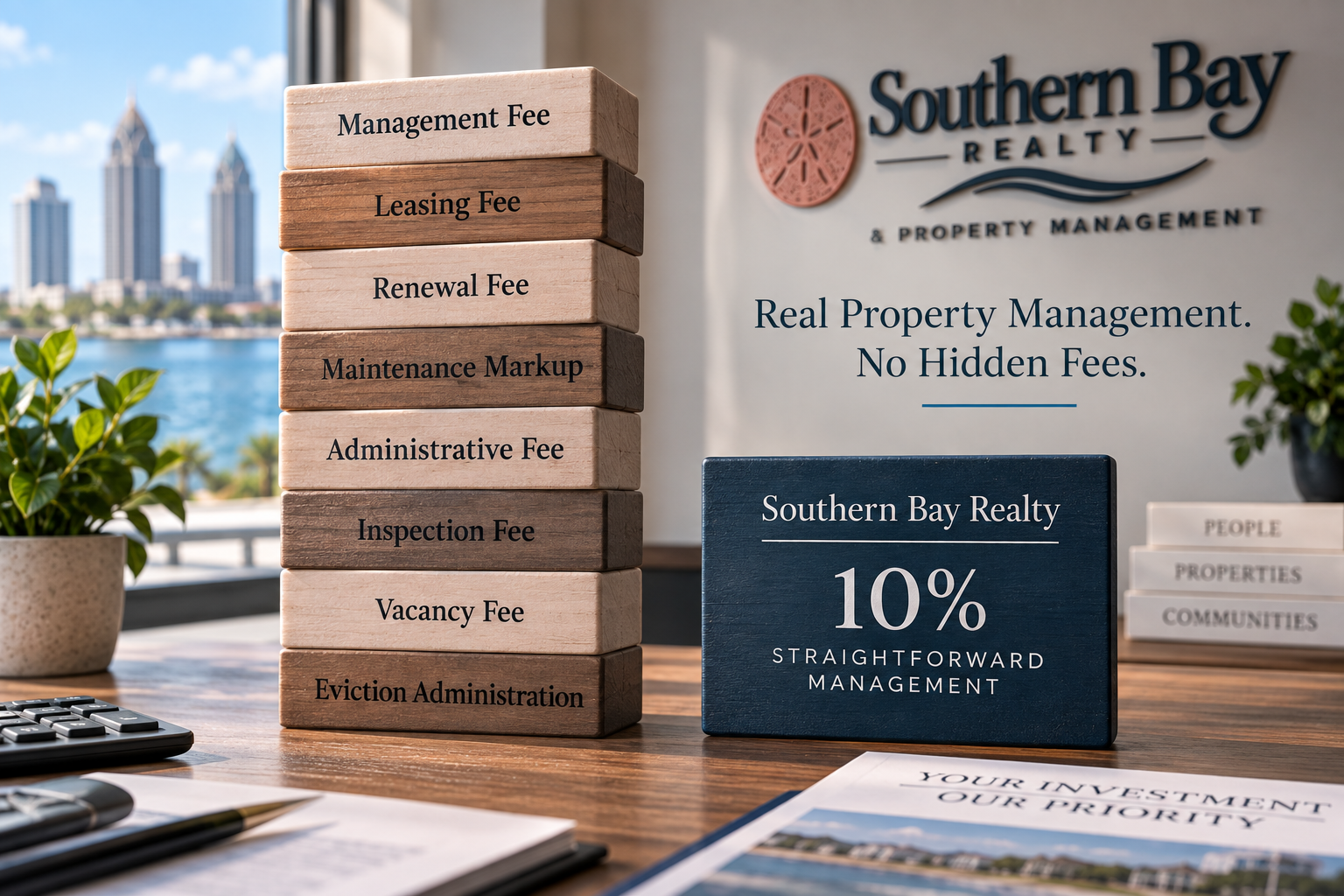
Property management fees do not have to be confusing. Before discussing the many types of fees that exist across the industry, we want to make one thing clear: Southern Bay Realty does not use a long list of management add-ons to nickel-and-dime property owners.
Our long-term residential management is a straightforward 10% management fee. We do not add separate leasing fees, tenant-placement fees, repair-coordination percentages, or extra management-company charges simply because routine parts of managing your property require work.
Vacation rentals use a different operating model and a different fee: 20% for a single vacation rental or 15% for multiple qualifying vacation-rental properties. Those percentages cover professional management; actual property operating expenses such as repairs, cleaning, supplies, taxes, and third-party platform expenses remain property expenses when applicable.
Other property management companies may structure their compensation very differently. This guide explains the fees you may encounter, what they usually mean, what questions owners should ask, and why comparing two management companies by the headline percentage alone can be misleading.
Straightforward management without leasing or repair-coordination add-ons.
Full-service short-term rental management for one property.
Reduced management rate for multiple qualifying properties.
First: A Management Fee Is Not the Same Thing as a Property Expense
This distinction is one of the most important concepts for owners to understand.
A management fee is compensation paid to the property management company for services it performs.
A property expense is an actual cost associated with owning or operating the property.
Examples of Management Fees
Monthly management percentages, leasing fees, renewal fees, maintenance markups, administrative fees, inspection fees, or other compensation retained by the manager.
Examples of Property Expenses
Plumber invoices, HVAC repairs, attorney charges, court filing costs, cleaning bills, supplies, platform fees, taxes, utilities, and other third-party costs incurred by the property.
A management company coordinating a $400 plumbing repair and paying the plumber $400 is very different from charging the owner $400 for the plumbing repair plus an additional 10% or 20% coordination fee.
Southern Bay Realty's no-nickel-and-diming philosophy concerns the management compensation we control. Owners remain responsible for legitimate third-party expenses their property incurs.
Back to Top ↑What Is a Property Management Fee?
The basic management fee is the primary amount paid to a property management company for handling ongoing operations.
For long-term residential management, the fee is commonly structured either as a percentage of rental income or as a flat monthly amount.
Services may include:
- Rent collection
- Tenant communication
- Lease administration
- Maintenance coordination
- Owner reporting
- Property documentation
- Renewal administration
- Routine management oversight
Collected rent vs. rent due
One detail owners should understand is whether the percentage is charged on rent that is actually collected or rent that was merely supposed to be collected.
Southern Bay Realty's long-term model is performance aligned: we get paid when the owner gets paid.
Our long-term property management service uses a straightforward 10% management fee rather than advertising a low percentage and then rebuilding our compensation through numerous additional management charges.
You can review our long-term property management services and pricing for more information about what is included.
Back to Top ↑What Is a Leasing or Tenant-Placement Fee?
Many management companies charge a separate fee whenever a new tenant is placed.
Depending on the company, the charge may be expressed as a flat amount, a percentage of one month's rent, or even a full month's rent.
What is the fee intended to cover?
- Advertising the vacancy
- Responding to prospects
- Showing coordination
- Application processing
- Tenant screening
- Lease preparation
- Move-in coordination
- Administrative work
There is nothing inherently improper about a leasing fee when it is clearly disclosed. It is simply one method of structuring management compensation.
Southern Bay Realty does not add a separate leasing or tenant-placement fee to our long-term management percentage.
That matters when comparing companies. A manager advertising 8% but charging a full month's rent every time a tenant changes may ultimately cost more than a manager with a slightly higher percentage and no leasing fee.
Back to Top ↑What Is a Lease-Renewal Fee?
Some property managers charge an additional fee when an existing tenant renews or extends a lease.
The reasoning is that renewals require work: reviewing market rent, communicating with the resident, preparing documents, obtaining signatures, updating records, and coordinating the next lease term.
Again, the issue is not necessarily whether a company uses that model. The important issue is whether the owner knows about it before signing the agreement.
Owners should ask:
- Is there a renewal charge?
- Is it flat or percentage based?
- Is it charged every renewal?
- Does month-to-month status create a fee?
- Is renewal work already included in management?
- When is the fee earned?
Southern Bay Realty's long-term philosophy is to keep routine management functions inside our straightforward management structure rather than turning each normal event in the tenancy into another owner charge.
Back to Top ↑What Are Maintenance Markups or Repair-Coordination Fees?
Maintenance is one area where management-company fee structures can differ substantially.
Some companies charge the owner the actual vendor invoice and then add an additional percentage or coordination charge for arranging, supervising, or processing the repair.
Example
That arrangement may be disclosed in a company's management agreement, but owners should know it exists because it can change the real cost of management—particularly on maintenance-heavy properties.
Southern Bay Realty does not add a repair-coordination percentage just because we schedule a vendor, communicate about a repair, or document routine maintenance.
The vendor's actual charge remains a property expense. Our management compensation remains our advertised management fee.
Back to Top ↑Who Keeps Tenant Late Fees?
This is an excellent question that many owners never think to ask.
A lease may require a resident to pay a late charge when rent is not paid by the required date. What happens to that money afterward depends on the management agreement.
Some companies retain all or a substantial portion of tenant late fees as additional property-management compensation.
Others credit the late fee to the property as rental income.
At Southern Bay Realty, tenant late fees are credited to the property's rental income rather than simply being taken by the management company. Our normal management percentage is then applied to the income collected.
Simple Example
Compare that with a structure in which the management company keeps the entire $100 late fee while still charging its normal percentage on the rent.
Neither structure should be hidden. Owners should know where tenant-paid fees go and how those funds appear on their statements.
Back to Top ↑What About Eviction Fees?
Evictions can involve several different types of expenses, and they should not all be lumped together under the phrase “eviction fee.”
Actual third-party costs may include:
- Attorney fees
- Court filing fees
- Service-of-process costs
- Constable or sheriff expenses
- Required notices
- Other legal expenses
Those are property expenses when they are legitimately incurred.
Some management companies, however, may also add their own management-company eviction administration fee on top of the attorney, court, and other third-party costs.
Southern Bay Realty does not add a separate management-company eviction surcharge simply because an eviction requires management coordination. Actual attorney, court, filing, service, or other third-party expenses remain property costs when incurred.
The distinction matters because an owner deserves to know whether a charge represents money paid to a third party or additional compensation retained by the property manager.
Back to Top ↑Other Property Management Fees Owners May Encounter
Property management agreements vary widely. Depending on the company and services involved, an owner may encounter additional charges beyond the primary management percentage.
Onboarding or Account Setup
Some companies charge an initial fee for creating owner accounts, entering property information, setting up software, or transferring records.
Property Inspections
A company may separately charge for periodic, move-in, move-out, drive-by, or other property inspections.
Technology or Administrative Fees
Some agreements include monthly technology, statement, portal, administrative, postage, or document-processing charges.
Vacant-Property Management
Some companies charge a minimum monthly fee even when a property produces no rent, while others charge additional amounts for vacancy oversight.
Early Termination Fees
Management contracts may include fees if an owner ends the agreement before a specified date or without the required notice.
Major Project Oversight
Extensive renovations or construction-management work may fall outside ordinary property management and may be addressed separately.
These examples do not mean every property manager charges these fees, nor does the existence of a separate fee automatically make a company unreasonable.
The purpose of understanding them is to allow owners to compare total cost and scope of service, not just one number advertised at the top of a website.
Back to Top ↑Vacation Rental Management Fees Work Differently
Short-term and vacation rentals require a much more active operating model than traditional long-term rentals.
Instead of one resident occupying a property under a long-term lease, vacation management can involve repeated bookings, dynamic nightly pricing, guest questions, arrivals, departures, cleanings, inspections, supplies, reviews, booking calendars, platform activity, and occupancy tax administration.
That is why vacation-rental management percentages are generally not directly comparable with long-term residential management percentages.
Full-service management for a single short-term rental.
Portfolio pricing for multiple qualifying vacation rentals.
Pricing, bookings, guests, cleanings, maintenance coordination, taxes, and reporting.
Third-party vacation rental costs are still operating expenses
A management percentage should not be confused with the other costs required to operate a vacation property.
Depending on the property, those may include:
- Cleaning charges
- Repairs
- Consumable supplies
- Linens
- Booking-platform charges
- Merchant-processing costs
- Occupancy taxes
- Utilities
These are not hidden management fees merely because the property manager coordinates them. They are actual costs of operating the vacation rental.
Southern Bay Realty's vacation rental management page explains our short-term management services, dynamic pricing, guest management, turnover coordination, and percentage structure in greater detail.
Back to Top ↑How to Compare Property Management Companies Fairly
The easiest mistake is comparing only the headline management percentage.
Imagine one company advertises 8% and another advertises 10%. At first glance, 8% appears cheaper.
But the comparison changes if the 8% company also charges:
- A leasing fee at every turnover
- A renewal fee each year
- A maintenance markup
- An inspection fee
- An administrative fee
- A vacancy charge
- Owner statement fees
- Additional eviction administration charges
Compare the total expected annual cost of management—not merely the percentage printed in the largest font.
Owners should also compare what is actually included. Lower management cost is not valuable if important services are missing, communication is poor, vacancy is higher, reporting is confusing, or maintenance oversight is weak.
Our article on the benefits of using a property manager provides a broader look at the operational value professional management can provide.
Back to Top ↑The Management Agreement Should Answer the Fee Questions
Marketing language is useful, but the management agreement is where the financial relationship should ultimately be defined.
Buildium's guide to property management agreements emphasizes the importance of clearly defining services, compensation, maintenance authority, termination terms, and other responsibilities.
Before signing an agreement, an owner should be able to answer these questions:
An owner should not need a spreadsheet and a calculator simply to understand how the manager gets paid.
Back to Top ↑Different Property Types Can Require Different Management Structures
Management pricing should also be evaluated in the context of the property being managed.
A long-term single-family rental, a multi-property residential portfolio, a vacation condominium, an HOA, and another real estate asset may require completely different services.
That is one reason comparing percentages without comparing scope can be misleading.
Our guide to the different types of property management explains how management responsibilities can change depending on the property and ownership structure.
Back to Top ↑The Cheapest Property Manager Is Not Automatically the Best Value
Fees matter because they directly affect investment performance. Owners should absolutely understand what they are paying.
But cost should be considered alongside performance.
Property management can influence:
- Vacancy
- Tenant quality
- Rent collection
- Property condition
- Maintenance response
- Tenant retention
- Owner reporting
- Documentation
- Compliance processes
- Your own time commitment
Saving a percentage point on management does not create value if poor pricing produces an extra month of vacancy or weak screening creates expensive turnover.
At the same time, an owner should not have to accept unnecessary fees simply because property management requires work.
Good pricing should be transparent enough that the owner understands both what the management costs and what the management company is responsible for delivering.
That principle is the foundation of Southern Bay Realty's no-nickel-and-diming approach.
Back to Top ↑Property Management Fees Should Be Easy to Understand
Property owners should know how their manager is compensated before management begins—not discover the real fee structure one statement at a time.
Across the industry, management companies may legitimately use different combinations of monthly management fees, leasing fees, renewal fees, maintenance markups, inspection charges, administrative fees, and other compensation structures.
The important questions are whether those fees are clearly disclosed, what services they cover, and what the total management relationship is likely to cost.
Southern Bay Realty takes a simpler approach.
Long-term residential management: 10%. No separate leasing fee. No repair-coordination markup. No routine management add-ons designed to rebuild the fee somewhere else.
Vacation rental management uses a separate full-service percentage because short-term rentals require substantially different operations: 20% for a single vacation property or 15% for multiple qualifying vacation properties.
Real third-party property expenses remain real property expenses. The difference is that we do not believe owners should be surprised by a new management-company charge every time their property requires ordinary management.
Back to Top ↑Frequently Asked Questions About Property Management Fees
What percentage does a property manager normally charge?
Property management pricing varies by market, property type, service level, and company. The percentage alone does not show the total cost because some managers separately charge leasing, renewal, maintenance, inspection, administrative, or other fees.
What does Southern Bay Realty charge for long-term property management?
Southern Bay Realty charges a straightforward 10% management fee for long-term residential property management. We do not add separate leasing fees or repair-coordination percentages to the normal management structure.
What does Southern Bay Realty charge for vacation rental management?
Southern Bay Realty's full-service vacation rental management rate is 20% for a single vacation property and 15% for owners placing multiple qualifying vacation rental properties under management.
Are repair costs included in a property management fee?
Usually not. The management fee pays the manager for management services. The actual plumber, HVAC technician, electrician, roofer, cleaner, attorney, or other vendor is a separate property expense. Owners should determine whether the management company also adds a markup or coordination charge to those invoices.
Does Southern Bay Realty charge a maintenance markup?
Southern Bay Realty does not add a repair-coordination percentage simply for arranging routine maintenance. The actual third-party vendor cost remains a property expense.
Who gets the late fee when a tenant pays rent late?
That depends on the management agreement. Some managers retain tenant late fees as additional compensation. At Southern Bay Realty, collected late fees are credited to the property's rental income, and the normal management percentage is applied to the collected income.
Does Southern Bay Realty charge an extra eviction fee?
Southern Bay Realty does not add a separate management-company eviction surcharge simply for coordinating the process. Actual attorney fees, filing fees, service costs, court costs, and other legitimate third-party expenses remain property expenses when incurred.
Why are vacation rental management fees higher than long-term management fees?
Vacation rental management involves a different level of ongoing activity, including dynamic nightly pricing, reservation management, guest communication, repeated turnovers, cleaning coordination, calendar management, platform activity, tax coordination, and frequent property-readiness oversight.
How should I compare two property management companies?
Compare the total expected annual cost, not only the headline management percentage. Review leasing fees, renewal charges, maintenance markups, late-fee treatment, inspection costs, administrative fees, vacancy charges, termination provisions, included services, communication, reporting, and overall management quality.
Property Management Without the Nickel-and-Diming
Southern Bay Realty provides straightforward long-term and vacation rental management throughout Mobile and Baldwin County with clearly defined pricing, professional oversight, organized reporting, and no confusing management-fee maze.
Talk With Southern Bay Realty