
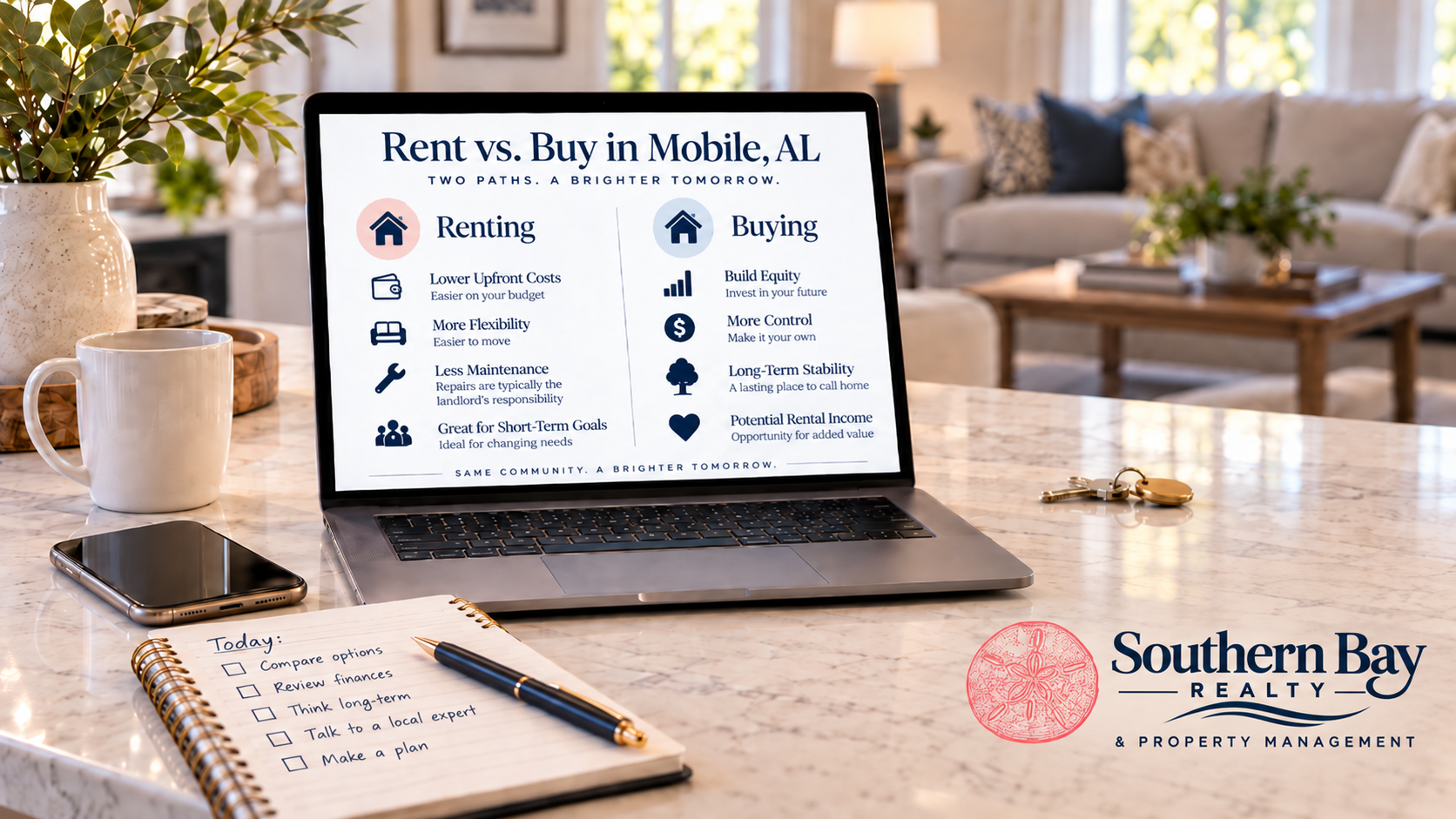
Rent vs. Buy in Mobile, AL: Which Makes More Sense for You?
There is no universal answer to whether renting or buying is better. The right choice depends on your finances, your timeline, your lifestyle, and what you want your housing decision to accomplish over the next several years.
For some people, buying a home can support long-term wealth building, provide greater control over where and how they live, and create an asset that may eventually become part of a broader investment strategy.
For others, renting provides valuable flexibility, requires less upfront cash, and reduces responsibility for major repairs at a time when homeownership might create unnecessary financial or lifestyle pressure.
At Southern Bay Realty, we believe the right answer should start with your goals—not with a sales pitch.
Explore Available PropertiesThe Real Question Is Not Simply “Which Is Cheaper?”
Rent-versus-buy decisions are often reduced to comparing one month's rent with one month's mortgage payment. That comparison is usually incomplete.
A better question is:
The answer may depend on your job stability, expected time in the area, available savings, tolerance for repairs, family plans, preferred neighborhood, desire for flexibility, long-term wealth goals, and whether you might eventually keep the property as a rental.
Someone who expects to remain in Mobile for years and wants to build ownership equity may reach a very different conclusion from someone who expects a job transfer, is still learning the area, or values the ability to relocate without first selling a home.
Neither choice is automatically financially superior. The right choice is the one that best fits the complete picture.
Back to Top ↑Why Renting Can Be the Smarter Choice
Renting is not simply “throwing money away.” Rent purchases housing, flexibility, and in many cases freedom from some of the largest and least predictable expenses associated with owning a home.
Renting may make sense when:
- You may relocate in the near future
- You are still learning which area fits you best
- You want to preserve cash
- You do not want major repair responsibility
- Your job or family plans are changing
- You value mobility
- Buying would stretch your budget
- You are rebuilding savings or credit
When an air conditioner fails, a roof leaks, or a water heater needs replacement, a renter generally reports the problem rather than funding the repair personally. That transfer of repair responsibility has genuine financial value.
Renting can also be a strategic choice for someone who is new to the Mobile area and still deciding whether Midtown, Downtown, West Mobile, Semmes, Saraland, Theodore, or another community best fits their commute, lifestyle, housing preferences, and long-term plans.
Back to Top ↑Why Buying Can Be the Better Long-Term Move
Buying becomes more attractive when the home fits both your current needs and your longer-term financial plan.
Potential advantages include:
- Building ownership equity over time
- Greater control over the property
- Ability to renovate and personalize
- Potential long-term appreciation
- Greater housing stability
- Potential future rental use
- Long-term wealth-building potential
- An asset that may support future goals
Real estate may appreciate over time, but appreciation is never guaranteed. A sound home purchase should still make sense if future appreciation is slower than hoped.
Buying is strongest when it is part of a broader plan—not simply a reaction to the idea that everyone is supposed to own a home.
Back to Top ↑Buying Can Support Long-Term Wealth Building
One of the fundamental differences between renting and buying is what happens to your housing payments over time.
Rent generally purchases the right to occupy a property for a defined period. With ownership, a portion of mortgage payments may reduce principal, creating equity as the loan balance declines.
Property values may also increase or decrease over time. That makes home ownership different from a guaranteed savings account: it has potential financial advantages, but it also carries market and property-specific risk.
Purchase price, financing, insurance, maintenance, property condition, neighborhood, transaction costs, and future resale or rental potential all influence the financial outcome.
For buyers thinking beyond a primary residence, our guide on how much money you need to invest in real estate explains why the purchase price is only one part of a larger investment strategy.
Back to Top ↑Compare Rent to the True Cost of Owning—Not Just the Mortgage
This is where many rent-versus-buy comparisons become misleading.
A mortgage payment is not the total cost of homeownership. Depending on the property, buyers may also need to budget for:
- Property taxes
- Homeowners insurance
- Flood coverage when applicable
- HOA or condominium dues
- Routine maintenance
- Utilities
- Pest and termite protection
- Major system replacement
- Lawn and tree care
- Unexpected repairs
Two homes with similar purchase prices can create very different monthly and annual ownership costs. Insurance, roof age, flood exposure, association fees, property condition, energy efficiency, and maintenance requirements can all make a meaningful difference.
Buyers should also account for the costs involved in obtaining the loan and completing the transaction—not merely the amount of the mortgage payment itself.
The Consumer Financial Protection Bureau's home-buying resources provide useful independent information about mortgages, loan estimates, closing costs, and preparing financially for homeownership.
The goal is not to discourage ownership. It is to compare the real cost of renting with the real cost of owning so the decision is based on the full financial picture.
Back to Top ↑Consider How Much Cash Buying Will Require
Monthly affordability is only one part of the decision. Buying a home can also require significant upfront cash.
Depending on the loan, transaction, property, and negotiated terms, buyers may need funds for:
- Down payment
- Closing costs
- Inspections
- Appraisal-related expenses
- Moving costs
- Immediate repairs
- Furniture or appliances
- Emergency reserves after closing
Using nearly every dollar of available savings to purchase a house can create vulnerability immediately after closing. A roof problem, HVAC repair, insurance deductible, vehicle expense, or temporary loss of income does not become less expensive because you recently purchased a home.
In some situations, continuing to rent while strengthening savings may put a buyer in a considerably better ownership position later.
Back to Top ↑How Long Do You Expect to Stay?
Your expected ownership period can significantly affect the rent-versus-buy decision.
Buying and eventually selling a home involve transaction costs. The longer you own a property, the more time you generally have to spread those costs across the ownership period.
There is no universal three-year, five-year, or other fixed rule that determines when buying becomes better than renting.
Your individual break-even point can depend on:
- Purchase price
- Financing terms
- Closing costs
- Future selling expenses
- Insurance and taxes
- Maintenance and improvements
- Comparable rental costs
- Changes in property value
If you already know your job, family, or lifestyle is likely to take you elsewhere soon, renting may be the more practical choice.
If you expect to remain in the area, have adequate financial reserves, and the complete costs of ownership fit comfortably within your budget, buying may deserve much stronger consideration.
Back to Top ↑Where You Live in Mobile Matters Too
“Mobile” is not one uniform housing market or lifestyle.
A buyer considering Midtown may be looking for something entirely different from someone comparing homes in West Mobile, Semmes, Saraland, Theodore, Downtown, or another part of Mobile County.
Your decision may be influenced by:
- Commute
- School preferences
- Home style and age
- Lot size
- Maintenance expectations
- Insurance considerations
- Neighborhood character
- Future resale or rental potential
Someone who is still exploring the area may benefit from renting before making a long-term commitment. That can provide time to learn traffic patterns, neighborhoods, commute preferences, and the types of homes that actually fit their lifestyle.
Someone who already understands the market, knows where they want to live, and expects to stay may place much greater value on beginning the ownership process sooner.
You can also explore current Southern Bay Realty property listings to see available options across the market.
Back to Top ↑What About Mortgage Rates, Home Prices, and Rent Changes?
Market conditions matter, but they should be evaluated as part of the decision rather than treated as the entire decision.
Mortgage rates rise and fall. Home prices can increase, flatten, or decline. Rental rates and available inventory can change. Insurance costs can change as well.
Trying to identify the perfect moment to buy can be difficult because several parts of the market are moving at the same time.
A lower interest rate does not automatically make an overpriced or unsuitable property a good purchase. A higher rate does not automatically make every purchase a bad one if the price, property, financing structure, timeline, and buyer's finances still make sense.
The same principle applies to renting. A temporary increase or decrease in rent should be considered alongside flexibility, expected length of stay, available cash, and the complete cost of ownership.
This is one reason we prefer evaluating current conditions for an individual client instead of building a rent-versus-buy decision around market statistics that quickly become outdated.
Back to Top ↑What If You Buy Now and Rent the Home Later?
For some buyers, the decision is not simply rent versus buy.
The more strategic question may be whether a home can serve as a primary residence today and potentially become an investment property later.
That can be a valuable strategy in the right situation, but future rental potential should be evaluated before the purchase—not assumed afterward.
Consider factors such as:
- Likely future market rent
- Property type and layout
- Neighborhood rental demand
- HOA or rental restrictions
- Future insurance considerations
- Property tax considerations
- Maintenance requirements
- Property management costs
If future rental use is part of your plan, our guide on how much rent you can realistically charge explains why rental pricing depends on much more than square footage.
Buyers considering this strategy can also learn more about our approach to real estate investment properties and how we help investors evaluate properties according to their individual financial and long-term goals.
Southern Bay Realty also provides professional long-term property management for owners who ultimately decide to keep a former residence as a rental.
Back to Top ↑Renting vs. Buying: A Practical Comparison
Renting May Make More Sense If...
Your situation values flexibility and lower ownership responsibility more than building home equity right now.
- You may move soon
- You want maximum flexibility
- You prefer lower repair responsibility
- Preserving cash is important
- Your long-term plans are uncertain
- Buying would create financial stress
Buying May Make More Sense If...
You have the financial capacity and timeline to make ownership part of a longer-term housing or investment strategy.
- You expect to stay longer
- You have adequate cash after closing
- You want to build equity
- You value housing stability
- You are comfortable with maintenance
- Ownership fits your long-term goals
Neither list automatically determines the answer. The right decision comes from examining the complete financial and lifestyle picture.
Back to Top ↑How Southern Bay Realty Helps You Decide
We do not believe the first question should simply be, “What house do you want to buy?”
We start with questions such as:
- What do the next several years look like for you?
- How important is flexibility?
- How much cash do you want to preserve?
- How comfortable are you with repairs?
- What areas of Mobile fit your lifestyle?
- Are you focused on stability or future mobility?
- Do you want the home to support wealth building?
- Could the property eventually become a rental?
We can help compare available properties, discuss likely ownership expenses, evaluate neighborhoods, examine potential rental use, and think through how a property fits your broader goals.
Sometimes the right answer is to buy. Sometimes the right answer is to continue renting while strengthening your finances or clarifying your plans.
Frequently Asked Questions About Renting vs. Buying
Is renting always wasting money?
No. Rent pays for housing, flexibility, and freedom from many major repair obligations. Renting does not create ownership equity, but that does not mean it provides no financial or lifestyle value.
Is buying always better for building wealth?
No. Buying can support long-term wealth building when the property, purchase price, financing, ownership costs, and expected holding period make sense. A poor real estate purchase can still be a poor financial decision.
Should I buy if my mortgage payment would be close to my rent?
Not based on that comparison alone. Buyers should also consider insurance, property taxes, maintenance, HOA costs, utilities, repairs, cash required at closing, future selling costs, and how long they expect to own the home.
How long should I live in a home before buying makes sense?
There is no universal minimum period. Your break-even point depends on the purchase price, financing, closing costs, maintenance, insurance, taxes, comparable rent, future selling expenses, and changes in the property's value.
What if I am new to Mobile?
Renting temporarily can be reasonable if you are still learning neighborhoods, commute patterns, housing styles, and lifestyle preferences. If you already know where you want to live and expect to remain in the area, buying may deserve stronger consideration.
Should mortgage rates determine whether I rent or buy?
Mortgage rates matter because they affect financing cost, but they are only one factor. Purchase price, available cash, ownership expenses, timeline, property condition, and long-term goals should also be evaluated.
Can I buy a home now and turn it into a rental later?
Potentially. Future rent, rental demand, insurance, taxes, property condition, HOA restrictions, maintenance, and management expenses should all be evaluated before relying on that strategy.
Is it better to wait until the housing market improves?
There is no single market condition that determines whether buying is appropriate for every buyer. The more useful question is whether a particular property, price, financing structure, and expected ownership period make sense for your individual situation.
Rent vs. Buy: Focus on Your Goals, Not the Headlines
The housing market will continue to change. Mortgage rates will change. Prices will change. Rents will change. Available inventory will change.
Your rent-versus-buy decision should therefore be built on something more durable than a snapshot of market conditions.
Consider your timeline, cash reserves, monthly budget, preferred area, tolerance for repairs, need for flexibility, and long-term financial goals.
Then evaluate the actual properties and financing options available to you when you are ready to make the decision.
Not Sure Whether Renting or Buying Makes More Sense?
Southern Bay Realty can help you compare your options based on your timeline, preferred area, available properties, ownership responsibilities, long-term financial goals, and future plans.
Talk With Southern Bay RealtyCall or text 251-227-8377