
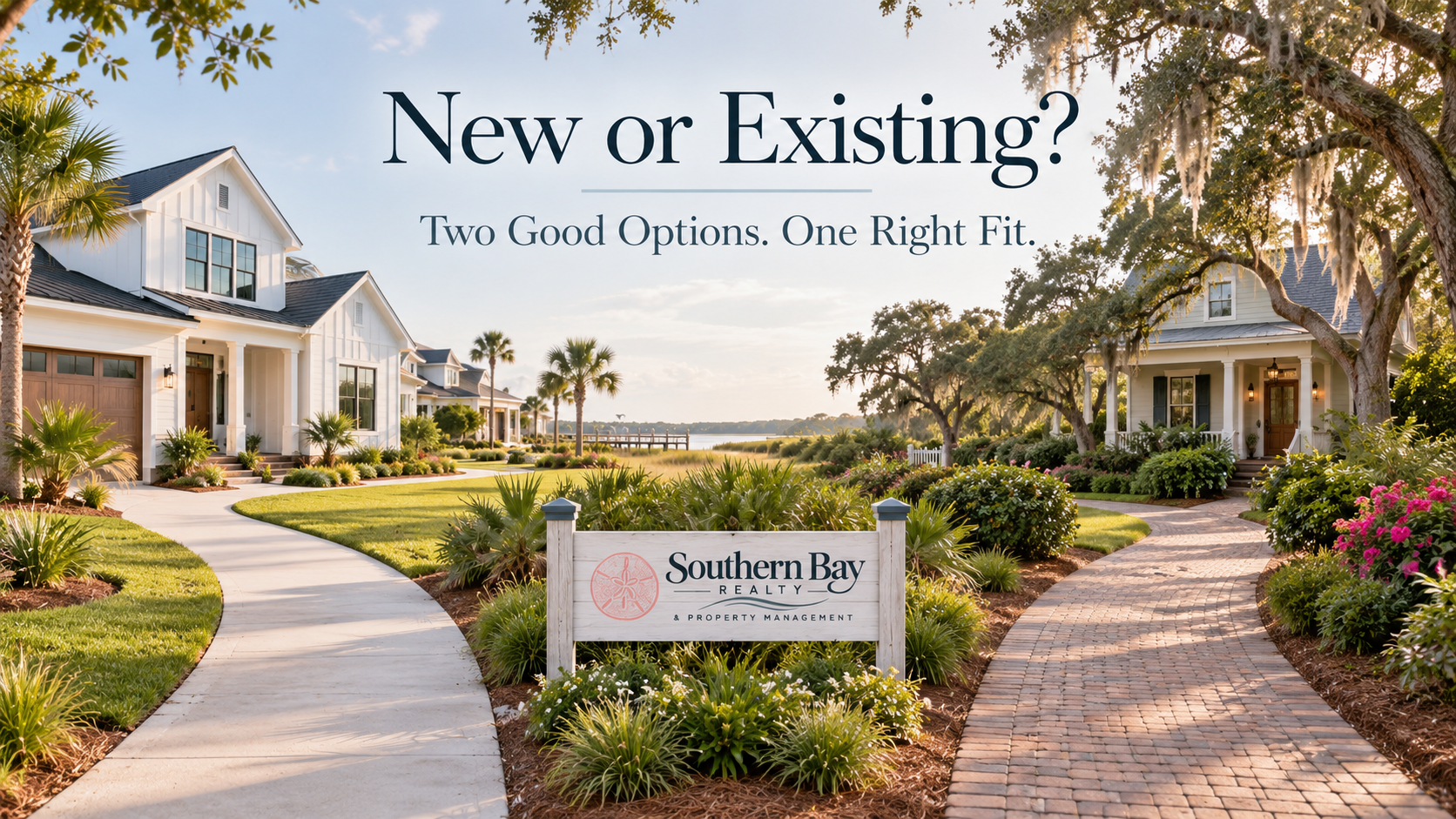
Should I Buy a New Construction or Existing Home?
One of the biggest decisions homebuyers face is whether to purchase a brand-new construction home or an existing home.
There is no universal winner. New construction may offer modern layouts, energy-efficient systems, builder warranties, and fewer immediate maintenance concerns. Existing homes may offer established neighborhoods, mature landscaping, larger lots, more negotiating opportunities, and a clearer picture of how the surrounding community has developed.
The better choice depends on your budget, timeline, preferred location, tolerance for repairs, financing, lifestyle, and long-term plans.
For buyers throughout Mobile and Baldwin County, Southern Bay Realty helps compare the entire purchase—not simply whether the appliances are new or the house has never been lived in.
New Construction vs. Existing Homes: The Big Picture
New and existing homes can both be excellent purchases, but they tend to offer different advantages.
New construction may appeal to buyers who prioritize:
- Modern floor plans
- New appliances and systems
- Energy efficiency
- Builder warranties
- Customization options
- Lower near-term maintenance
- Modern finishes
- New neighborhood amenities
Existing homes may appeal to buyers who prioritize:
- Established neighborhoods
- Mature trees and landscaping
- Larger or unique lots
- Architectural variety
- Immediate availability
- Known neighborhood conditions
- Potential negotiation opportunities
- More location choices
Those categories are helpful starting points, but they do not tell the whole story. Two homes with the same price can have very different total ownership costs, future maintenance needs, HOA obligations, insurance expenses, financing options, and resale potential.
Back to Top ↑Advantages of Buying New Construction
There is an obvious appeal to being the first person to live in a home. Everything is new, finishes are typically current, and major systems should have years of useful life ahead of them.
Modern layouts and features
New homes are generally designed around current buyer preferences. Depending on the builder and price point, that can include open living spaces, larger kitchens, improved storage, modern electrical capacity, smart-home features, updated bathrooms, and more functional floor plans.
Buyers purchasing early enough in the construction process may also have opportunities to choose flooring, cabinets, countertops, fixtures, paint colors, or other finishes.
Newer major systems
A newly constructed house generally starts with a new roof, HVAC system, electrical components, plumbing, water heater, appliances, windows, and other building components.
That does not mean nothing will ever go wrong, but it can reduce the likelihood that a buyer immediately faces the kinds of large replacement expenses commonly associated with aging homes.
Energy efficiency
Modern construction techniques, insulation, windows, HVAC equipment, appliances, and building standards can make newer homes more energy efficient than many older homes.
Actual utility costs will still depend on the home, size, construction quality, thermostat habits, local weather, and utility rates.
Builder warranties
Many builders provide some form of warranty coverage, although the scope and duration can vary significantly.
Buyers should understand exactly what is covered, for how long, how claims are submitted, what is excluded, and whether different portions of the home have different warranty periods.
Potential Drawbacks of New Construction
New construction offers significant benefits, but buyers should also understand its tradeoffs.
The advertised price may not be the final price
A model home often includes upgrades that are not part of a builder's base package.
Features that may add to the purchase price can include:
- Premium flooring
- Upgraded countertops
- Cabinet upgrades
- Lighting packages
- Appliance upgrades
- Lot premiums
- Covered patios
- Additional landscaping
There may also be post-closing expenses for blinds, fencing, landscaping, additional storage, gutters, security systems, or other items that an existing home might already include.
Construction timelines can change
If the home is not complete when you sign the contract, your closing date may depend on construction progress.
Weather, labor availability, inspections, permitting, material availability, subcontractor schedules, and other issues can affect completion.
This becomes especially important if you are coordinating the sale of another home, ending a lease, arranging movers, or locking a mortgage interest rate.
The neighborhood may still be developing
A new subdivision can look very different five years after you buy than it does today.
Future phases may add homes, roads, traffic, amenities, commercial development, or other changes. Landscaping may still be immature, and construction activity may continue around you for some time.
Freddie Mac recommends researching both the builder and the surrounding community, including looking into future development that could affect what is around the property. Their guidance also recommends working with an agent familiar with new construction and the local area.
Read Freddie Mac's tips for buying new construction .
Back to Top ↑Advantages of Buying an Existing Home
Existing homes should not be viewed simply as the alternative for buyers who cannot afford new construction. In many cases, an existing property may offer characteristics that are difficult or expensive to duplicate in a new development.
Established locations
Older neighborhoods often provide something new construction cannot immediately recreate: time.
Roads, trees, landscaping, neighboring homes, traffic patterns, nearby businesses, schools, parks, and surrounding development already exist. Buyers can evaluate the neighborhood largely as it is rather than relying as heavily on development plans.
More architectural and property variety
Existing homes can offer larger lots, mature trees, established landscaping, unique architectural styles, workshops, detached garages, pools, additions, or other features that may be difficult to find in newer subdivisions.
More immediate availability
An existing home usually does not require waiting for construction to finish.
Once financing, inspections, title work, appraisal, and other contract requirements are completed, the transaction can generally move toward closing without relying on a construction schedule.
Potential negotiating opportunities
Every transaction is different, but an individual homeowner may have different motivations than a builder.
Depending on market conditions and the property, negotiations can involve price, repairs, closing costs, personal property, timing, or other contract terms.
Back to Top ↑Potential Drawbacks of Existing Homes
An existing home's age is not automatically a problem. Condition matters much more than the year printed on the tax record.
However, buyers should understand that older systems may have less remaining useful life.
Items worth evaluating can include:
- Roof age and condition
- HVAC age
- Electrical system
- Plumbing
- Water heater
- Windows and doors
- Foundation or structure
- Appliances
- Drainage
- Exterior condition
- Insulation
- Deferred maintenance
A home that costs less at closing could become more expensive if major systems need replacement shortly afterward.
On the other hand, an older home with a recently replaced roof, HVAC system, updated plumbing, renovated kitchen, and other improvements might compare very favorably with new construction.
Compare the True Cost—not Just the Purchase Price
The sticker price is only one part of deciding whether a new or existing home is the better financial choice.
A thoughtful comparison should consider:
- Purchase price
- Mortgage payment
- Interest rate
- Closing costs
- Property taxes
- Homeowners insurance
- Flood insurance when applicable
- HOA dues
- Expected maintenance
- Immediate repairs
- Desired renovations
- Builder upgrades
New does not always mean more expensive
Although new construction may carry a price premium, builders sometimes offer financing incentives, closing-cost assistance, upgrade packages, or other concessions.
Those incentives can materially change the economics of a purchase.
Existing does not always mean cheaper
An existing home may have a lower purchase price but require flooring, paint, appliances, HVAC replacement, roofing, electrical updates, or renovations after closing.
The most useful comparison is therefore not simply:
"Which house has the lower price?"
It is:
Financing Can Change the Comparison
Financing deserves special attention when comparing new construction with an existing home.
Builders frequently work with preferred lenders and may offer incentives tied to using those lenders. These incentives can include contributions toward closing costs, rate-related incentives, or other financial benefits.
That can be valuable, but buyers should still understand the complete loan terms and compare the overall cost rather than looking only at the incentive.
Freddie Mac specifically advises new-construction buyers to choose their lender carefully, understand loan terms and rate-lock periods, and shop for financing that fits their financial situation.
Your homebuying team matters
The real estate agent, lender, and title company perform separate but interconnected roles during a purchase.
Your agent helps with the property, contract, negotiation, inspections, deadlines, and transaction. Your lender handles financing requirements and loan approval. The title company examines ownership and title matters and helps facilitate closing.
Understanding how real estate brokerages, lenders, and title companies work together can make both new-construction and existing-home transactions easier to navigate.
Back to Top ↑Do I Need a Home Inspection on New Construction?
Yes—new construction should not automatically be treated as a substitute for an independent home inspection.
A new house was still built by people, subcontractors, and multiple trades working through a construction process. Items can be installed incorrectly, overlooked, damaged during later stages of construction, or simply need correction.
Depending on the stage of construction and the transaction, buyers may discuss different inspection opportunities with their agent and inspector.
A final inspection of a completed new home may identify issues involving:
- Electrical components
- Plumbing
- HVAC operation
- Roofing
- Attic conditions
- Drainage
- Windows and doors
- Appliances
- Interior finishes
- Exterior components
Freddie Mac's consumer guidance specifically recommends having a home inspection even when purchasing new construction so potential issues can be identified before move-in.
Existing homes need careful evaluation too
With an existing home, inspection findings can provide valuable information about the current condition of the property and potentially significant future expenses.
An inspection is not a guarantee that nothing will ever go wrong, but it can help buyers make a more informed decision before completing a purchase.
New Construction Is Often Connected to an HOA
Many new subdivisions are governed by homeowners associations, making the HOA itself an important part of the buying decision.
An HOA can provide advantages such as maintained common areas, community amenities, architectural standards, and neighborhood maintenance.
It can also create additional obligations, including:
- Regular HOA dues
- Community rules
- Architectural restrictions
- Parking restrictions
- Rental restrictions
- Pet restrictions
- Potential assessments
- Approval requirements
Existing homes can also be located in HOA communities, so this is not exclusively a new-construction issue.
Before purchasing, buyers should review the association's governing documents, fees, applicable restrictions, and available financial information rather than assuming every HOA functions the same way.
If you are considering an HOA property, our guide to buying in an HOA neighborhood explores the advantages, restrictions, costs, and other issues buyers should consider.
Back to Top ↑What About Future Resale Value?
Buyers understandably want to know whether new construction or an existing home is likely to hold its value better.
There is no universal answer.
Future resale value can be influenced by:
- Location
- Neighborhood demand
- Lot quality
- Home condition
- School zones
- Nearby development
- Floor plan
- Insurance costs
- HOA conditions
- Housing supply
- Property improvements
- Overall market conditions
The new-construction competition problem
One consideration that buyers sometimes overlook is what happens if they need to sell while the builder is still actively selling brand-new homes nearby.
Your resale property may then compete with the builder's new inventory, model homes, financing incentives, closing-cost incentives, warranties, and customization options.
That does not make buying in a developing subdivision a bad decision, but it is something worth understanding when considering your likely holding period.
Established neighborhoods have their own advantages
An existing neighborhood may offer a clearer history of resale activity, established amenities, mature landscaping, known traffic patterns, and fewer unanswered questions about how the area will ultimately develop.
Ultimately, location and buyer demand generally matter more than simply labeling a home "new" or "used."
Back to Top ↑How Do I Decide Between New Construction and an Existing Home?
Start by identifying the things that actually matter most to you instead of starting with the age of the home.
New construction may make more sense if you:
- Want modern finishes and layouts
- Prefer fewer immediate repairs
- Value builder warranty coverage
- Want customization opportunities
- Prefer newer systems
- Can accommodate construction timing
- Like newer planned communities
- Find builder incentives attractive
An existing home may make more sense if you:
- Want an established neighborhood
- Prefer mature landscaping
- Need a more predictable move date
- Want broader location options
- Prefer unique architecture
- Want a larger or established lot
- Are comfortable evaluating repairs
- Want more varied housing inventory
For many buyers, the answer changes once they begin looking at actual properties.
You may initially believe you only want new construction and then discover an established neighborhood you love. Or you may expect to buy an existing home and find that builder incentives, lower expected maintenance, and a particular floor plan make new construction more appealing.
Frequently Asked Questions About New vs. Existing Homes
Is new construction always more expensive than an existing home?
No. New construction may have a higher base purchase price, but builder incentives, financing terms, lower near-term maintenance, and included features can affect the comparison. Existing homes may cost less initially but require repairs or improvements. Buyers should compare the total financial picture.
Do I need my own real estate agent when buying from a builder?
Having your own real estate professional can be valuable because the builder and its sales representatives are involved in selling the builder's product. Your agent can help you evaluate the property, community, contract terms, comparable sales, negotiations, inspections, incentives, and transaction process.
Freddie Mac recommends that new-construction buyers find their own agent and notes that some builders may require the buyer's agent to accompany the buyer during the first visit to the community.
Should I use the builder's preferred lender?
Sometimes a preferred lender may offer valuable incentives. That does not mean buyers should evaluate the incentive in isolation. Compare the interest rate, loan terms, fees, closing costs, rate-lock provisions, and overall financing package.
Do new homes still need inspections?
Yes. A new home can still have construction defects, incomplete work, improperly installed components, or items requiring correction. An independent inspection can help identify issues before closing or move-in.
Are builder warranties the same as a home inspection?
No. A warranty describes certain obligations the builder may have after construction under the terms of that warranty. An inspection evaluates the property's condition. Buyers should understand both.
Can I negotiate the price of new construction?
Possibly, but builder negotiations can work differently from negotiations with an individual homeowner. Builders may sometimes prefer offering closing-cost assistance, upgrades, financing incentives, or other concessions rather than reducing the recorded sales price.
Are existing homes more expensive to maintain?
Not necessarily. Age can increase the likelihood that certain systems will need repair or replacement, but actual condition matters more than age alone. A well-maintained existing home with recently replaced major systems may have fewer near-term maintenance concerns than expected.
Which type of home is better for resale?
Neither category automatically wins. Location, demand, condition, lot, floor plan, neighborhood, local supply, financing conditions, insurance costs, and broader market conditions can all affect resale value.
Is buying new construction more complicated?
It can involve different considerations. Builder contracts, construction timelines, selections, change orders, completion dates, warranties, preferred lenders, inspections, and development plans can make the process different from purchasing a completed existing home.
Back to Top ↑Final Thoughts: New Construction or Existing Home?
Both new construction and existing homes can be excellent choices.
New construction may provide modern features, newer systems, customization, warranty protection, and reduced near-term maintenance concerns.
Existing homes may provide established neighborhoods, mature landscaping, more varied architecture, broader location choices, quicker occupancy, and properties whose surrounding communities are already developed.
The key is to compare more than surface-level features.
Consider purchase price, financing, insurance, taxes, HOA obligations, maintenance, repairs, upgrades, location, inspections, neighborhood development, resale potential, and how long you expect to own the property.
At Southern Bay Realty, our role is not to convince every buyer that new construction is better or that an existing home is better. It is to help you evaluate the options, understand the tradeoffs, and find the property that makes the most sense for your needs throughout Mobile and Baldwin County.
Back to Top ↑Not Sure Which Type of Home Is Right for You?
Talk with Southern Bay Realty about your budget, preferred location, financing, lifestyle, timeline, and long-term goals. We can help you compare new construction and existing homes throughout Mobile and Baldwin County and find the property that fits you best.
Start Your Home Search