
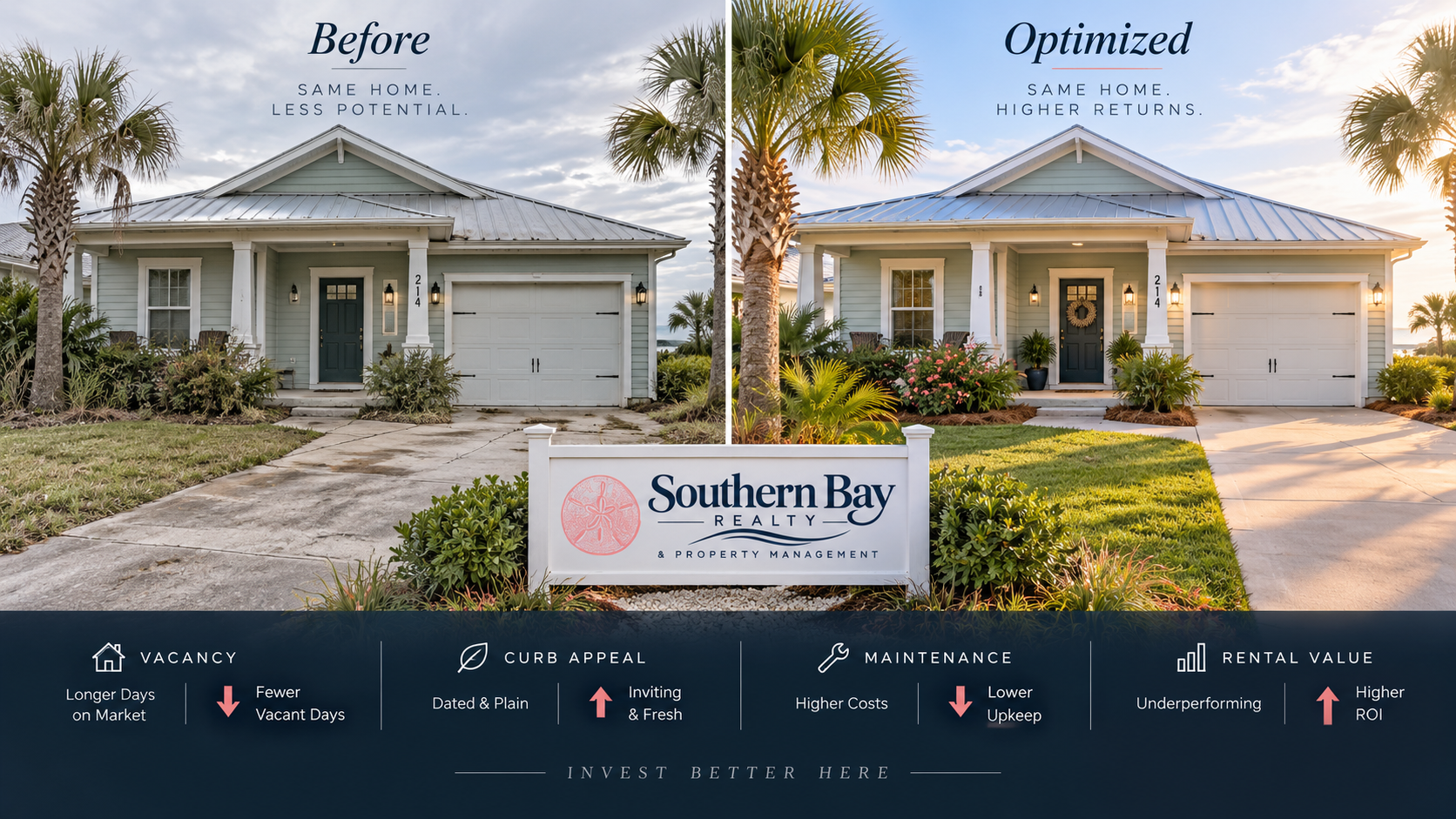
How to Maximize Rental Property ROI in Mobile and Baldwin County
Strong rental-property returns rarely come from one dramatic decision. They usually come from buying the right property, setting the right rent, controlling vacancy, selecting tenants carefully, managing expenses, and making dozens of smaller decisions correctly over time.
Rental property throughout Mobile County and Baldwin County can offer very different opportunities depending on location, purchase price, tenant demand, insurance exposure, property condition, neighborhood, and the type of rental strategy being used.
This guide focuses primarily on long-term residential rentals: homes generally leased to residents for extended periods rather than marketed by the night or week.
Vacation rentals in Gulf Shores, Orange Beach, Fort Morgan, Dauphin Island, and other tourism-driven areas operate under a different revenue model. We explain that distinction below so investors do not mistakenly evaluate a long-term rental using short-term rental logic.
Discuss Your Rental InvestmentRental Property ROI Is More Than Monthly Rent
Investors sometimes judge a property by asking a single question: “How much rent can I charge?”
Rental income matters, but it is only one side of the equation.
A property that produces impressive gross rent can still perform poorly if vacancy, repairs, insurance, financing, turnover, utilities, management costs, or capital expenses consume too much of that income.
Long-term rental performance can be influenced by:
- Gross monthly rent
- Actual collected rent
- Vacancy
- Maintenance
- Tenant turnover
- Insurance
- Property taxes
- Management expenses
- Financing costs
- Capital improvements
- Long-term appreciation
- Equity accumulation
The goal is not simply to maximize rent. The goal is to maximize the property's long-term net performance.
1. Choose the Right Property in the Right Location
Rental ROI begins before a tenant ever moves in.
The purchase price, neighborhood, property type, condition, expected rent, insurance expense, maintenance profile, and likely tenant pool all affect long-term performance.
A property that looks inexpensive may not be a bargain if it requires constant repairs, attracts inconsistent demand, carries unusually high operating costs, or needs frequent tenant turnover to remain occupied.
Evaluate more than purchase price
- Neighborhood rental demand
- Likely tenant profile
- Comparable market rent
- Property condition
- Roof and HVAC age
- Flood exposure
- Insurance cost
- School-zone demand
- Commute access
- Long-term resale appeal
The best investment is not necessarily the cheapest property or the one with the highest theoretical rent. It is the property whose complete economics fit the investor's strategy.
Back to Top ↑2. Understand That Mobile County and Baldwin County Are Different Rental Markets
One of the biggest mistakes an investor can make is treating the Alabama Gulf Coast as one uniform rental market.
Mobile County and Baldwin County can have very different acquisition costs, insurance considerations, tenant demand, rental expectations, property types, and investment strategies.
Mobile County
Long-term residential investing in Mobile County often centers around traditional single-family rentals and other residential properties serving households seeking stable housing near employment, schools, medical facilities, transportation corridors, and established neighborhoods.
West Mobile, Midtown, Semmes, Saraland, Theodore, Tillmans Corner, Grand Bay, and other areas can each have different tenant pools and achievable rental rates.
Baldwin County
Baldwin County is even more diverse. Daphne, Spanish Fort, Fairhope, Foley, Robertsdale, Loxley, Bay Minette, and other communities have substantial long-term rental demand.
Meanwhile, Gulf Shores, Orange Beach, Fort Morgan, and nearby coastal communities include a large concentration of properties that may be evaluated partly or primarily as vacation rentals.
Your property-management and pricing strategy should match the specific submarket—not merely the county where the property is located.
3. Set the Right Long-Term Rental Price
Pricing is one of the most important parts of maximizing long-term rental ROI.
Many owners assume the best strategy is simply to charge the highest rent the market might tolerate.
That can backfire.
Every additional week a property remains vacant reduces effective annual rent. Owners still may be responsible for mortgage payments, insurance, taxes, utilities, lawn care, and maintenance while collecting no rent at all.
A slightly lower monthly rent with strong occupancy can outperform an aggressive asking price that creates prolonged vacancy.
Long-term rental pricing should consider:
- Current competing rentals
- Recently leased comparable properties
- Bedrooms and bathrooms
- Property condition
- Neighborhood demand
- School zones
- Garage and parking
- Fenced yards
- Pet policies
- Included utilities or amenities
- Lease length
- Current inventory
Our guide on how much rent you can charge explains how local property characteristics and competition influence achievable rental value.
You can also review our guide on how to set the right rental price for your property for additional discussion of pricing strategy.
Broader resources such as RentCafe's national rental market trends can provide useful context, but national or statewide averages should never replace property-specific local analysis.
Back to Top ↑4. Long-Term Rental Pricing and Vacation Rental Pricing Are Not the Same
This distinction is especially important for investors operating in Baldwin County and on Dauphin Island.
A long-term rental and a vacation rental may be the same physical property, but they operate under very different revenue models.
Stable Monthly Pricing
Long-term rental pricing generally focuses on the monthly market rate that can support stable occupancy under an extended lease.
The investor usually prioritizes predictable income, tenant quality, lower turnover, controlled maintenance, and reduced vacancy.
Dynamic Nightly Pricing
Vacation rentals typically use pricing that changes according to demand rather than maintaining one fixed monthly rate.
Rates may change by season, day of the week, holidays, local events, booking window, property availability, occupancy patterns, and competing vacation-rental inventory.
Vacation-rental revenue is more complicated
A beachfront or tourism-oriented property might command a strong nightly rate during a high-demand period and a substantially different rate during a slower period.
Owners also need to evaluate occupancy—not merely the nightly rate.
A vacation rental may involve additional expenses such as:
- Frequent cleaning
- Guest communication
- Booking platform expenses
- Furnishings
- Linens and supplies
- Utilities
- Internet
- Higher turnover
- Dynamic pricing management
- Seasonal occupancy swings
A $300 nightly rate does not mean the property earns $9,000 per month. Vacation rental performance depends on both rate and occupancy—and the operating-cost structure is substantially different.
For that reason, this article's recommendations about rent pricing, tenant placement, lease renewals, and vacancy are primarily directed toward long-term rental properties.
Vacation-rental owners need a separate revenue-management strategy built around dynamic pricing, occupancy forecasts, seasonal demand, and short-term operating expenses.
Back to Top ↑5. Reduce Vacancy Without Sacrificing Tenant Quality
Vacancy is one of the largest hidden expenses in long-term rental ownership.
A rental that earns $2,000 per month but sits empty for two months does not actually produce $24,000 in annual rent.
That is why effective rent should matter more than the advertised rent.
Ways to reduce unnecessary vacancy include:
- Price accurately from the beginning
- Use strong listing photography
- Market across appropriate channels
- Respond quickly to qualified prospects
- Keep the property showing-ready
- Start renewal discussions early
- Plan turnover work before vacancy occurs
- Track local competing inventory
Vacancy reduction does not mean approving weak applications or ignoring established screening standards. The goal is to attract qualified applicants efficiently.
Back to Top ↑6. Screen Tenants Consistently
A rental property can be priced perfectly and still underperform if the tenancy creates repeated nonpayment, damage, conflict, or unnecessary turnover.
Tenant screening should be based on clearly established, consistently applied standards rather than subjective decisions made from one applicant to the next.
Screening may consider factors such as:
- Income qualification
- Rental history
- Credit information
- Identity verification
- Employment information
- Other lawful qualification criteria
Owners should understand applicable Fair Housing and consumer-reporting requirements and apply their standards uniformly.
Our comprehensive guide on how to screen tenants explains the subject in much greater detail for owners managing their own rentals.
Back to Top ↑7. Upgrade Strategically—Not Emotionally
Rental-property improvements should usually be evaluated differently from improvements to a personal residence.
The goal is not necessarily to create the owner's dream kitchen. The goal is to make improvements that support rentability, durability, tenant appeal, and long-term property value.
Improvements that may add practical value include:
- Durable flooring
- Fresh neutral paint
- Updated lighting
- Functional kitchens
- Improved bathroom condition
- Fenced yards where appropriate
- Improved curb appeal
- Energy-efficient systems
A $20,000 improvement is not automatically a good rental investment simply because it makes the property nicer.
Ask whether the improvement is likely to increase rent, reduce vacancy, reduce future repairs, improve tenant retention, or support resale value.
Back to Top ↑8. Control Maintenance Costs Without Deferring Necessary Repairs
Maintenance has a direct effect on ROI, but cutting maintenance indiscriminately can make the property more expensive to own.
Small leaks become water damage. Minor HVAC problems can become major system failures. Poor drainage can create moisture problems. Deferred exterior maintenance can accelerate deterioration.
Gulf Coast humidity, heat, heavy rainfall, storms, and long cooling seasons make preventive maintenance especially important.
Strong maintenance systems include:
- Reliable contractor relationships
- Preventive HVAC service
- Routine property observations
- Roof monitoring
- Drainage awareness
- Prompt leak response
- Documented repair history
- Capital-expense planning
The objective should be cost control—not neglect.
Back to Top ↑9. Good Tenant Retention Can Protect ROI
Turnover creates expenses.
Even when the next tenant eventually pays more rent, the owner may first experience vacancy, cleaning, repairs, utilities, advertising, leasing, and administrative work.
That means a reliable tenant paying a reasonable market rent may sometimes be more valuable than constantly attempting to reset the property to the highest theoretical rent.
Tenant retention can improve when owners:
- Respond to legitimate repairs
- Communicate professionally
- Maintain the property
- Apply lease policies consistently
- Begin renewal discussions early
- Keep rent reasonably aligned with market conditions
This does not mean rent should never increase. It means increases should be considered as part of the property's overall performance rather than viewed in isolation.
Back to Top ↑10. Watch the Expenses That Quietly Reduce ROI
Rental-property performance is often damaged by dozens of small expenses rather than one dramatic loss.
Review costs such as:
- Insurance
- Property taxes
- HOA dues
- Lawn maintenance
- Pest control
- Utilities during vacancy
- Leasing expenses
- Turnover repairs
- Management fees
- Recurring vendor charges
- Capital expenditures
- Financing costs
Baldwin County coastal properties may carry an entirely different cost structure from inland Mobile County rentals, particularly when insurance, wind exposure, flood considerations, condominium fees, or association costs are involved.
That is why gross rent alone is a poor way to compare two investment properties.
Back to Top ↑11. Decide Whether Professional Management Improves the Investment
Property management is an expense—but self-management is not free.
Owners who manage their own rentals invest time into advertising, screening, lease administration, rent collection, maintenance, tenant communication, inspections, documentation, accounting, and turnover.
Professional management may make sense when the systems, time savings, tenant placement, maintenance coordination, reporting, and operational consistency add more value than the management fee consumes.
Management can become especially valuable when:
- You own multiple properties
- You live away from the property
- You value passive ownership
- Maintenance coordination is difficult
- Tenant communication consumes too much time
- Your portfolio is growing
- Documentation is becoming complicated
- You want professional reporting
The right question is not simply, “What does management cost?”
The better question is: “What does the property perform like with good management compared with what it performs like without it?”
12. Measure the Property's Actual Performance
An investor should periodically evaluate whether a property is accomplishing what it was purchased to accomplish.
That requires looking beyond gross rent.
Use real collected income rather than the maximum advertised monthly rent.
Empty periods and tenant changes can materially reduce annual returns.
Know what insurance, taxes, repairs, management, utilities, landscaping, and other costs are actually consuming.
Roofs, HVAC systems, appliances, flooring, and major repairs eventually require investment.
A property should be evaluated according to the investor's strategy, risk tolerance, cash-flow objectives, and long-term plan.
A property with modest current cash flow may still fit an investor focused on equity and appreciation. Another investor may prioritize stronger immediate cash flow.
There is no single ideal investment-property profile for everyone.
Back to Top ↑Maximizing Rental ROI Requires Managing the Whole Investment
Successful long-term rental investing in Mobile County and Baldwin County is not simply about finding the highest monthly rent.
The property, purchase price, financing, location, tenant quality, vacancy, maintenance, insurance, taxes, operating expenses, and management strategy all affect the final return.
Long-term rentals generally reward stability, careful tenant placement, controlled expenses, and consistent occupancy.
Vacation rentals can also produce attractive returns, particularly in tourism-driven coastal markets, but they should be evaluated under a separate model that accounts for dynamic nightly pricing, seasonality, occupancy, cleaning, guest turnover, furnishings, platform costs, and more active revenue management.
The best investment strategy is the one designed around the specific property, the specific market, and the investor's individual long-term goals.
Southern Bay Realty helps investors throughout Mobile and Baldwin County evaluate rental property, estimate realistic rent, consider operating costs, and build a strategy around the property's long-term performance.
Back to Top ↑Frequently Asked Questions About Rental Property ROI
What is the best way to increase ROI on a long-term rental property?
Strong ROI usually comes from a combination of accurate rent pricing, low vacancy, careful tenant screening, controlled maintenance expenses, strategic improvements, tenant retention, and purchasing the right property at a price that supports the investor's goals.
Should I always charge the highest possible rent?
No. An aggressive asking rent can increase vacancy and reduce effective annual income. The better goal is often to establish a competitive market rent that supports strong occupancy and long-term performance.
Are Mobile County and Baldwin County similar rental markets?
No. Both counties contain multiple submarkets with different purchase prices, rental demand, tenant profiles, insurance costs, property types, and investment strategies. Properties should be evaluated based on their specific location and competition.
Is vacation rental pricing the same as long-term rental pricing?
No. Long-term rentals generally use a relatively stable monthly rental rate under an extended lease. Vacation rentals frequently use dynamic nightly pricing that changes with season, occupancy, weekends, holidays, events, booking patterns, and competing inventory.
Can a vacation rental generate more revenue than a long-term rental?
It can in the right market and property, but gross revenue alone does not determine profitability. Vacation rentals may also involve cleaning, utilities, furnishings, supplies, platform costs, guest turnover, management, and significant seasonal occupancy changes.
How important is tenant screening to rental ROI?
Tenant placement can materially affect property performance. Consistent screening can help reduce the risk of nonpayment, unnecessary turnover, and other tenancy problems while helping owners identify applicants who meet established qualification criteria.
Should I renovate a rental property before increasing rent?
Not automatically. Improvements should be evaluated according to likely rent increase, reduced vacancy, tenant appeal, durability, maintenance savings, and future resale value. Expensive upgrades do not always produce a proportional rental return.
Does professional property management reduce ROI?
Management creates an expense, but its effect on ROI depends on the value it provides. Better tenant placement, reduced vacancy, maintenance coordination, consistent rent collection, reporting, and time savings may offset or exceed the management cost for some owners.
Want to Improve the Performance of Your Rental Property?
Southern Bay Realty can help you evaluate long-term rental pricing, tenant demand, operating costs, property condition, and management strategy throughout Mobile County and Baldwin County.
Talk With Southern Bay Realty